Farrago 2.2.0
Farrago 2.2.0 for Mac
Play beds, stingers, and effects on cue without hunting files in Finder mid-take.
Drop clips on a grid, then fire them from the keyboard
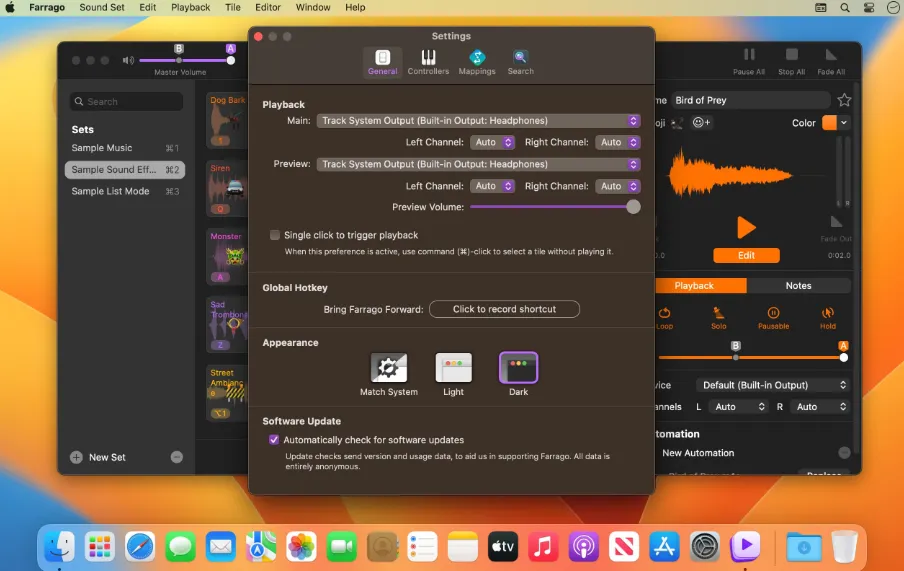
The usual first hour is download the vendor trial, drag audio onto a board, and assign keys. Each tile has an Inspector for name, color, emoji, volume, loop, and fade. A built-in editor trims and fades without bouncing out to another DAW. Search covers your library, Freesound (login from Settings), and Apple Loops if GarageBand or Logic is installed. Multiple sets keep show packs apart; Smart Sets refill from rules. Lock a set — optionally with a password — when a shared booth should not rearrange tiles.
Grid mode is the instant-access layout. List mode is the showrunner: order clips, add notes, play in sequence. A Preview output lets you audition on a second device before the live bus hears it. Search finds a title even when the library is huge. Single-click playback is optional; command-click can fire a tile in a background window without stealing focus.
List mode, hardware, and routing into a show
MIDI, Stream Deck, and OSC can trigger tiles when a keyboard is the wrong surface. Shortcuts.app can start or configure sets and sounds; you can also run a Shortcut from inside Farrago. Many booths route Farrago into Audio Hijack or a Loopback virtual device so beds sit under a mic — those are separate purchases. Preview versus program output is the built-in split. Dark theme and a studio-oriented tile UI are the default look.
Trial noise, licenses, and the 2.2 floor
Version 2.2.0 (9 Sep 2026) requires macOS 14 or later, adds Golden Gate launch support, expands Shortcuts, and tightens the editor with I/O selection, loop, and draggable handles. The same download is trial and full app: after 20 plays per launch, noise is overlaid until you quit and reopen. A single-user key is $55 and covers one person on personally owned Macs; Farrago 1 keys (FEBE-) upgrade for $25. There is no Mac App Store listing. Refunds are advertised as case-by-case within 14 days. QLab or a hardware mixer still win for complex theatrical cue lists; this is the faster tile board for podcasts and small venues.