
Hexagon CAEfatigue 2025.2
Hexagon CAEfatigue 2025.2 Download
Advanced Random Impact Analysis Algorithms, Many automotive and aerospace systems require load analysis and collision avoidance of individual components under severe vibration conditions caused by in-service shock. An efficient frequency domain analysis technique has been developed to perform durability and response assessment in a single analysis. Using the data obtained from advanced random impact analysis, root mean square (RMS) displacements, velocities, accelerations, and forces, as well as power spectral density (PSD) plots can be determined for both absolute and relative responses of the structure. Additionally, a residual sum of squares (RSS) is calculated to account for all cross-responses.
New post-processing features allow the relative response of any node to be compared with other nearby nodes to check for collisions with adjacent components and to perform chatter analysis. The maximum response is determined by the root mean square (i.e. 3.0*RMS) value of the deviation from the corresponding probability level obtained according to the Gaussian or Rayleigh distribution, or using a method taking into account the number of response cycles. The results of calculations using the algorithm for calculating the response to random action (Advanced Random Analysis) are an excellent complement to the tasks of predicting the response of a structure under complex loading conditions, which are encountered in many engineering problems in a wide variety of industries.
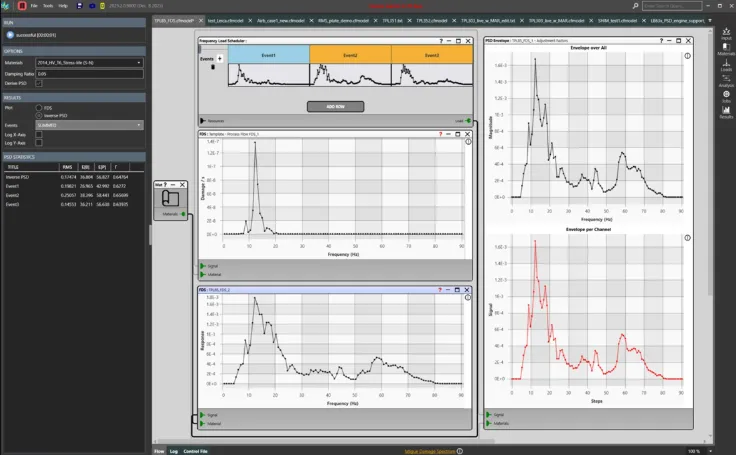
Calculation of Surrogate Loads
In strength analysis, the characterization of the applied loads is of great importance. Ideally, all loads used in the analysis or in laboratory testing should correspond as closely as possible to the values achieved in service of the product. In practice, the closest scenario that can be realized is to measure several events and input loads (taking into account their correlation) on prototype vehicles tested at the proving grounds and reproducing them in the laboratory or analytical environment. From an analytical point of view, this is the most feasible and widely used method, but it poses a significant problem of test acceleration. In laboratory simulations, especially when simulating individual components or assemblies, it is necessary to simplify the loads, usually due to the availability of test equipment, to a single input load applied cyclically (e.g. along the X, then Y, then Z axis), which creates significant difficulties. Currently, two general approaches are used. The first involves applying a wrapping procedure to the loads, according to which several loads are combined into a smoothed profile. The classic application of this procedure does not require knowledge of the system structure, so it does not provide any assurance that the resulting loads will result in the same values or the same damage distribution