
Pulsar Modular ZORBA v1.0.0 for Macos
Pulsar Modular ZORBA v1.0.0 for Macos Free Download
Most soft synths give you too many options and not enough soul. ZORBA flips that. It is built around one question: what does a synthesizer sound like when it keeps the warmth of classic analog machines but is not trapped by their original architecture?
The answer is a plugin that feels alive the moment you load a preset. There is zero sample delay. No plugin d
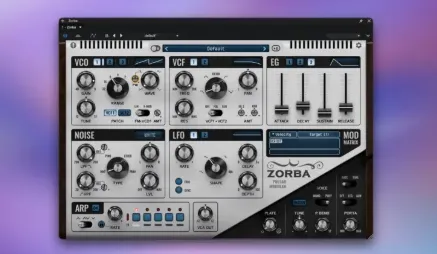
elay compensation. Keys trigger notes with nothing in between. Mac users running Apple Silicon get a Universal Binary build, so ZORBA loads fast and runs light. You can stack multiple instances without thinking about CPU load.
Features
- Three-Oscillator Architecture: ZORBA has two primary oscillators and one dedicated sub oscillator. VCO1 and VCO2 share a single morph knob. That knob slides continuously between Saw, Square, Triangle, and Sine. There is no switching between fixed shapes. You sweep through tonal color in real time. This makes basses, leads, and pads evolve naturally as you play. The Hybrid zone between 0.50 and 0.60 on the morph knob produces bright odd-harmonic tones that fixed-waveform synths cannot reach. Route an envelope here for a reverse-brightness bloom on every note. VCO3 is a fully independent sub oscillator. It sits one octave below the main pair. It has its own tune, gain, and filter routing. Bring it in for sub bass weight. Keep it out when you need a clean top end.
- Dual 904-F State Variable Filters: The filter section is the heart of ZORBA. Two independent 904-F State Variable Filters run in parallel, series, or split across the oscillators. Each filter has four modes: low-pass, band-pass, high-pass, and notch. Every filter passes through four resonance zones. It starts clean. It moves into self-oscillation. It hits transformer-style saturation. Then it reaches what Pulsar Modular calls the Black Hole rebirth zone. That range gives ZORBA everything from vintage smoothness to unstable, experimental textures. Split routing is especially powerful. Send VCO1 through VCF1 in low-pass mode and VCO2 through VCF2 in band-pass mode. The result is a formant-style lead that no single-filter synth can produce.


